







Adapting to different layouts and pedestrian interactions
Real-robot demonstrations
Navigating around obstacles and moving pedestrians
How cooperation changes the response to occlusion
Abstract
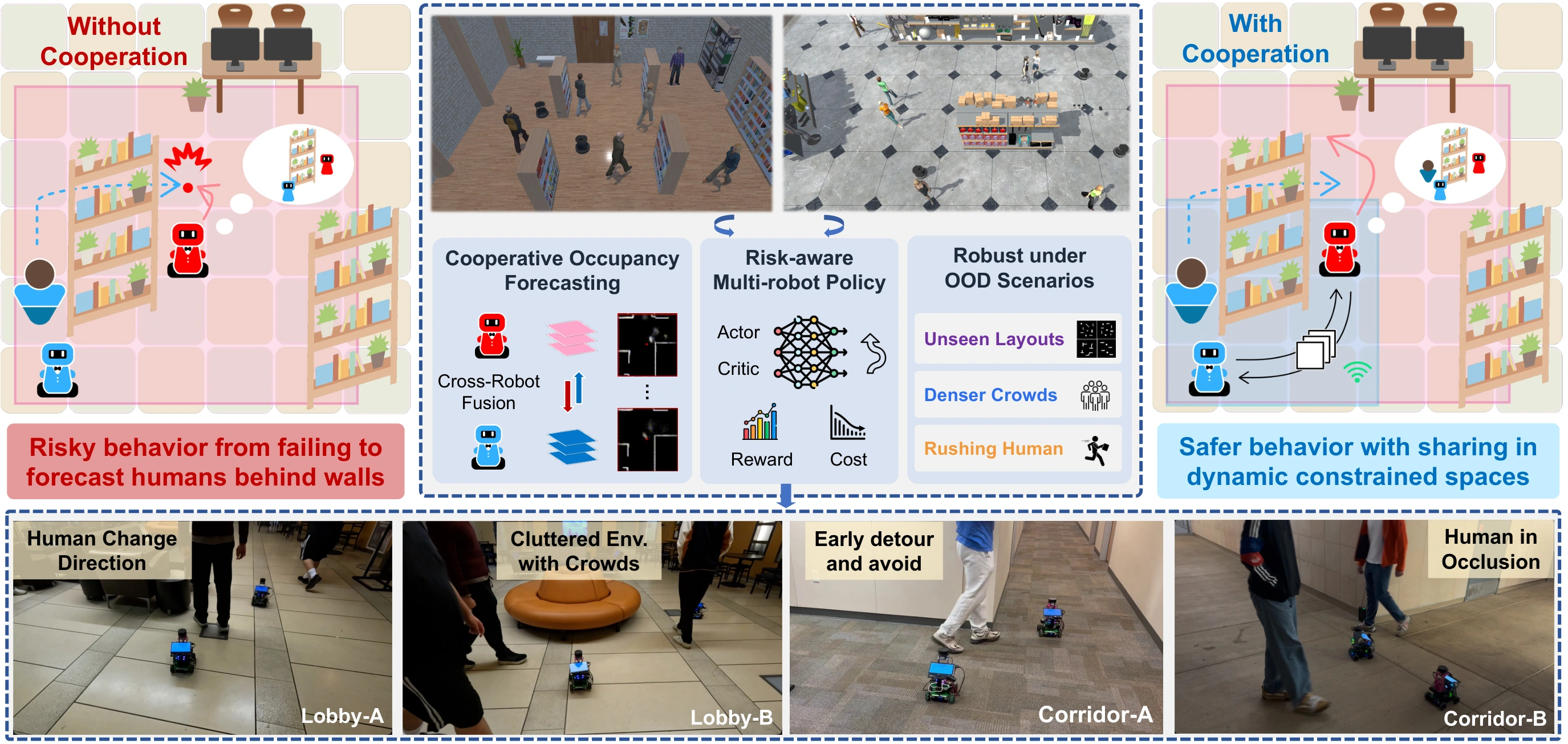
Reinforcement learning enables mobile robots to make fast and scalable navigation decisions in constrained human-shared environments. However, directly extending single-robot approaches to multi-robot settings often fails to ensure safety and efficiency, especially under occlusions and out-of-distribution (OOD) scenarios, where individual robots may overlook potential risks or make inaccurate predictions. Leveraging cooperation effectively for both prediction and navigation remains a major challenge. We propose CoopUQ, a multi-robot social navigation framework that bridges uncertainty-aware cooperative occupancy forecasting and robust decision making. CoopUQ predicts future occupancy grid maps through cross-robot spatiotemporal feature fusion and further leverages forecasts and their uncertainty to guide policy via constrained multi-agent reinforcement learning, where the cost penalizes navigation through regions predicted to be occupied or highly uncertain. This design enables the policy to adapt its risk sensitivity under distribution shifts. Experimental results across multiple Unity3D-based simulation environments with both in-distribution and OOD settings, including diverse layouts, pedestrian densities, and rushing behavior, demonstrate improved prediction performance and safety over representative baselines. Real-robot experiments further demonstrate its robustness across various scenes.
Method
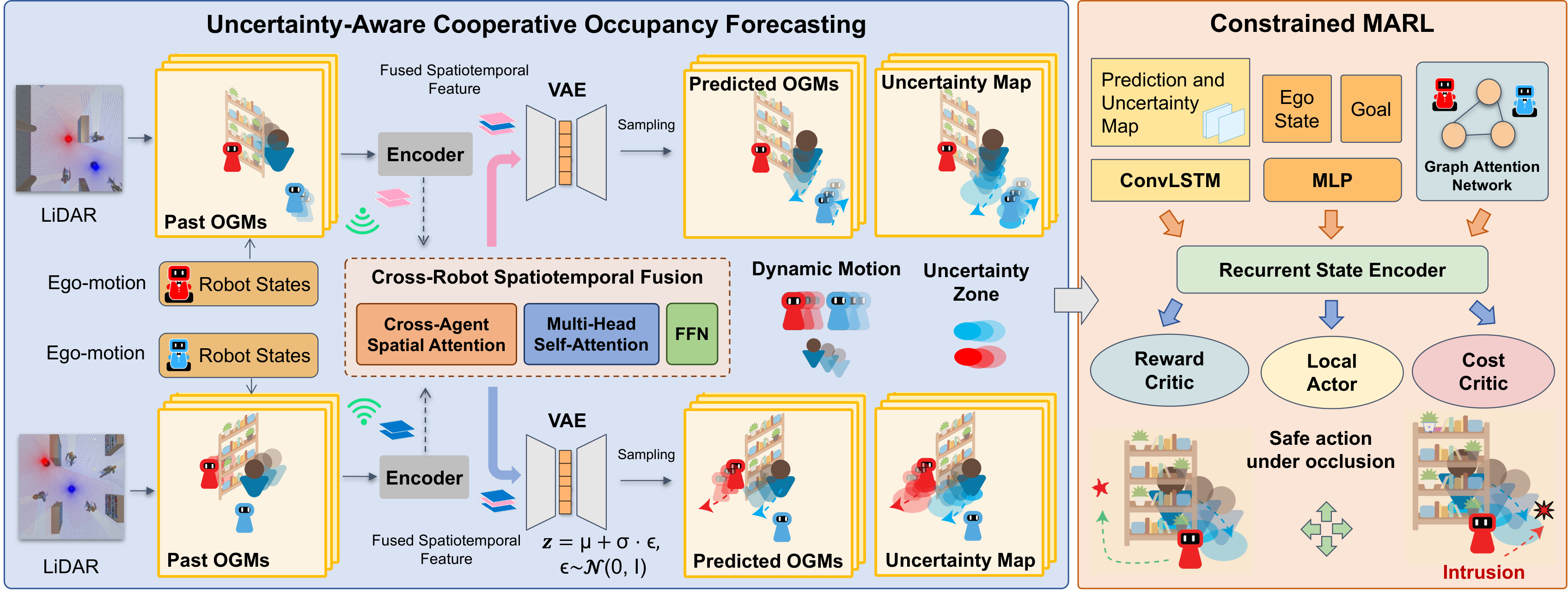
CoopUQ links where robots need information to where they should exercise caution. Each robot encodes its LiDAR-derived occupancy history and aligns neighboring features to its own frame. Spatial disagreement between these features provides a cue for a learned fusion gate, encouraging the use of complementary observations in occluded or inconsistent regions while preserving reliable local evidence. A variational autoencoder samples possible future occupancy maps, with pixel-wise entropy used to construct uncertainty maps. Crucially, predicted occupancy and high uncertainty also contribute to an explicit cost constraint in MAPPO-Lagrangian training, allowing the policy to adapt its risk sensitivity under occlusions and distribution shifts while avoiding unnecessary conservatism in well-observed regions.
Cooperative Forecasting in Challenging Scenes
Clean Communication
Communication Delay or Localization Noise
Sustains Reliable Navigation as Robot Teams Grow
In-distribution

Unseen layouts
Rushing pedestrians
Denser crowds
Can Cooperation Improve Forecasts
despite Delays and Noisy Poses?
| Cooperation | Method | Horizonsteps | SSIM ↑Structural similarity | WMSE ↓Weighted mean squared error | IoU ↑Intersection over union | ||||||
|---|---|---|---|---|---|---|---|---|---|---|---|
| Clean | Delay200 ms | Loc. noise | Clean | Delay200 ms | Loc. noise | Clean | Delay200 ms | Loc. noise | |||
| No cooperation | SOGMP++ | 1 | 0.75 ± 0.00 | — | — | 0.16 ± 0.00 | — | — | 0.60 ± 0.01 | — | — |
| 5 | 0.71 ± 0.00 | — | — | 0.19 ± 0.00 | — | — | 0.57 ± 0.01 | — | — | ||
| Early fusion | CoopUQ | 1 | 0.86 ± 0.00 | 0.79 ± 0.01 | 0.74 ± 0.01 | 0.07 ± 0.00 | 0.13 ± 0.01 | 0.15 ± 0.01 | 0.73 ± 0.01 | 0.65 ± 0.01 | 0.58 ± 0.02 |
| 5 | 0.80 ± 0.00 | 0.74 ± 0.01 | 0.68 ± 0.02 | 0.12 ± 0.00 | 0.15 ± 0.01 | 0.20 ± 0.01 | 0.68 ± 0.01 | 0.60 ± 0.02 | 0.53 ± 0.02 | ||
| Late fusion | CoopUQ | 1 | 0.81 ± 0.01 | 0.78 ± 0.01 | 0.76 ± 0.01 | 0.12 ± 0.00 | 0.13 ± 0.01 | 0.15 ± 0.01 | 0.63 ± 0.01 | 0.61 ± 0.02 | 0.59 ± 0.02 |
| 5 | 0.76 ± 0.01 | 0.74 ± 0.01 | 0.71 ± 0.02 | 0.14 ± 0.01 | 0.15 ± 0.01 | 0.17 ± 0.01 | 0.60 ± 0.01 | 0.58 ± 0.02 | 0.56 ± 0.02 | ||
| Middle fusion | CoopUQ | 1 | 0.90 ± 0.00 | 0.88 ± 0.01 | 0.84 ± 0.01 | 0.05 ± 0.00 | 0.06 ± 0.01 | 0.08 ± 0.01 | 0.77 ± 0.01 | 0.74 ± 0.01 | 0.68 ± 0.01 |
| 5 | 0.86 ± 0.00 | 0.84 ± 0.01 | 0.80 ± 0.01 | 0.09 ± 0.00 | 0.10 ± 0.01 | 0.12 ± 0.01 | 0.72 ± 0.01 | 0.72 ± 0.02 | 0.64 ± 0.02 | ||
What Happens When Layouts
and Pedestrian Behavior Change?
- Success rate (%)
- Collision rate (%)
- Timeout rate (%)
CoopUQ Generalizes to Larger Teams without Retraining
| Method | SR ↑Success rateID / OOD | CR ↓Collision rate | TR ↓Timeout rateID / OOD | NT ↓Nav. time (s)ID / OOD | PL ↓Path length (m)ID / OOD | AA ↓Avg. accel.ID / OOD | ITR ↓Intrusion (%)ID / OOD | SD ↑Social dist. (m)ID / OOD | ||
|---|---|---|---|---|---|---|---|---|---|---|
| ObstacleID / OOD | HumanID / OOD | RobotID / OOD | ||||||||
| ORCA | 0.47 / 0.37 | 0.17 / 0.15 | 0.23 / 0.38 | 0.06 / 0.08 | 0.06 / 0.02 | 10.04 / 10.54 | 9.30 / 11.12 | 0.10 / 0.11 | 7.63 / 11.80 | 0.36 / 0.34 |
| SAMARL | 0.65 / 0.53 | 0.10 / 0.14 | 0.12 / 0.21 | 0.05 / 0.06 | 0.07 / 0.06 | 12.98 / 13.45 | 14.99 / 15.57 | 0.18 / 0.20 | 6.60 / 10.43 | 0.37 / 0.34 |
| SCOPE | 0.67 / 0.56 | 0.10 / 0.10 | 0.11 / 0.18 | 0.03 / 0.05 | 0.09 / 0.11 | 13.39 / 14.79 | 15.67 / 16.92 | 0.18 / 0.21 | 5.56 / 7.56 | 0.38 / 0.36 |
| HEIGHT | 0.70 / 0.60 | 0.07 / 0.08 | 0.13 / 0.19 | 0.03 / 0.05 | 0.06 / 0.07 | 12.43 / 13.49 | 13.80 / 14.11 | 0.14 / 0.15 | 4.08 / 8.02 | 0.37 / 0.36 |
| CoopUQ | 0.90 / 0.82 | 0.03 / 0.04 | 0.03 / 0.10 | 0.00 / 0.01 | 0.03 / 0.03 | 9.80 / 10.88 | 11.98 / 13.82 | 0.13 / 0.17 | 2.07 / 4.47 | 0.45 / 0.43 |
| ORCA | 0.44 / 0.34 | 0.18 / 0.13 | 0.20 / 0.37 | 0.12 / 0.14 | 0.05 / 0.02 | 9.97 / 10.73 | 9.36 / 11.26 | 0.10 / 0.10 | 7.04 / 11.14 | 0.37 / 0.34 |
| SAMARL | 0.62 / 0.51 | 0.11 / 0.14 | 0.10 / 0.18 | 0.08 / 0.11 | 0.08 / 0.06 | 13.07 / 13.62 | 15.21 / 15.89 | 0.18 / 0.20 | 6.03 / 9.26 | 0.36 / 0.34 |
| SCOPE | 0.66 / 0.56 | 0.10 / 0.11 | 0.12 / 0.18 | 0.06 / 0.06 | 0.07 / 0.09 | 13.35 / 14.80 | 15.88 / 16.89 | 0.18 / 0.21 | 6.31 / 7.01 | 0.38 / 0.36 |
| HEIGHT | 0.70 / 0.61 | 0.08 / 0.09 | 0.13 / 0.18 | 0.04 / 0.06 | 0.04 / 0.05 | 12.78 / 13.40 | 14.38 / 14.05 | 0.15 / 0.15 | 3.90 / 7.09 | 0.37 / 0.36 |
| CoopUQ | 0.88 / 0.81 | 0.03 / 0.05 | 0.05 / 0.10 | 0.01 / 0.01 | 0.02 / 0.02 | 10.62 / 11.71 | 12.62 / 14.86 | 0.13 / 0.17 | 2.26 / 4.42 | 0.44 / 0.42 |
| ORCA | 0.38 / 0.30 | 0.14 / 0.12 | 0.20 / 0.34 | 0.24 / 0.24 | 0.03 / 0.01 | 9.99 / 10.26 | 9.21 / 10.86 | 0.10 / 0.11 | 7.03 / 10.72 | 0.34 / 0.33 |
| SAMARL | 0.53 / 0.44 | 0.11 / 0.14 | 0.07 / 0.17 | 0.21 / 0.20 | 0.07 / 0.06 | 13.85 / 13.77 | 16.00 / 16.03 | 0.19 / 0.21 | 5.84 / 9.47 | 0.37 / 0.34 |
| SCOPE | 0.62 / 0.52 | 0.12 / 0.11 | 0.12 / 0.20 | 0.10 / 0.11 | 0.04 / 0.06 | 13.75 / 14.22 | 16.49 / 16.38 | 0.18 / 0.21 | 7.60 / 7.92 | 0.37 / 0.36 |
| HEIGHT | 0.57 / 0.56 | 0.14 / 0.14 | 0.19 / 0.19 | 0.08 / 0.08 | 0.01 / 0.03 | 12.78 / 13.57 | 14.61 / 14.37 | 0.15 / 0.16 | 5.48 / 7.08 | 0.36 / 0.36 |
| CoopUQ | 0.84 / 0.78 | 0.04 / 0.06 | 0.05 / 0.10 | 0.02 / 0.02 | 0.04 / 0.03 | 12.85 / 13.55 | 16.16 / 17.16 | 0.16 / 0.18 | 2.95 / 4.62 | 0.42 / 0.40 |
All learned policies are trained with three robots and evaluated with five and ten robots without retraining.
Does the Learned Policy Transfer to Real Robots?
- Success rate (%)
- Collision rate (%)
- Timeout rate (%)
Averaged over four indoor environments (two lobbies and two corridors), four trials per environment and pedestrian count.
BibTeX
@inproceedings{wang2026coopuq,
  title     = {CoopUQ: Robust Multi-Robot Social Navigation via
               Uncertainty-Aware Cooperative Forecasting},
  author    = {Wang, Zehao and Yao, Jianpeng and Wang, Yuping and
               Li, Yiping and Li, Jiaqi and Li, Zhixu and Lee, Kanghoon and
               Wang, Jinfeng and Liu, Cong and Tan, Zhaowei and
               Park, Jinkyoo and Li, Jiachen},
  booktitle = {10th Conference on Robot Learning (CoRL)},
  year      = {2026}
}